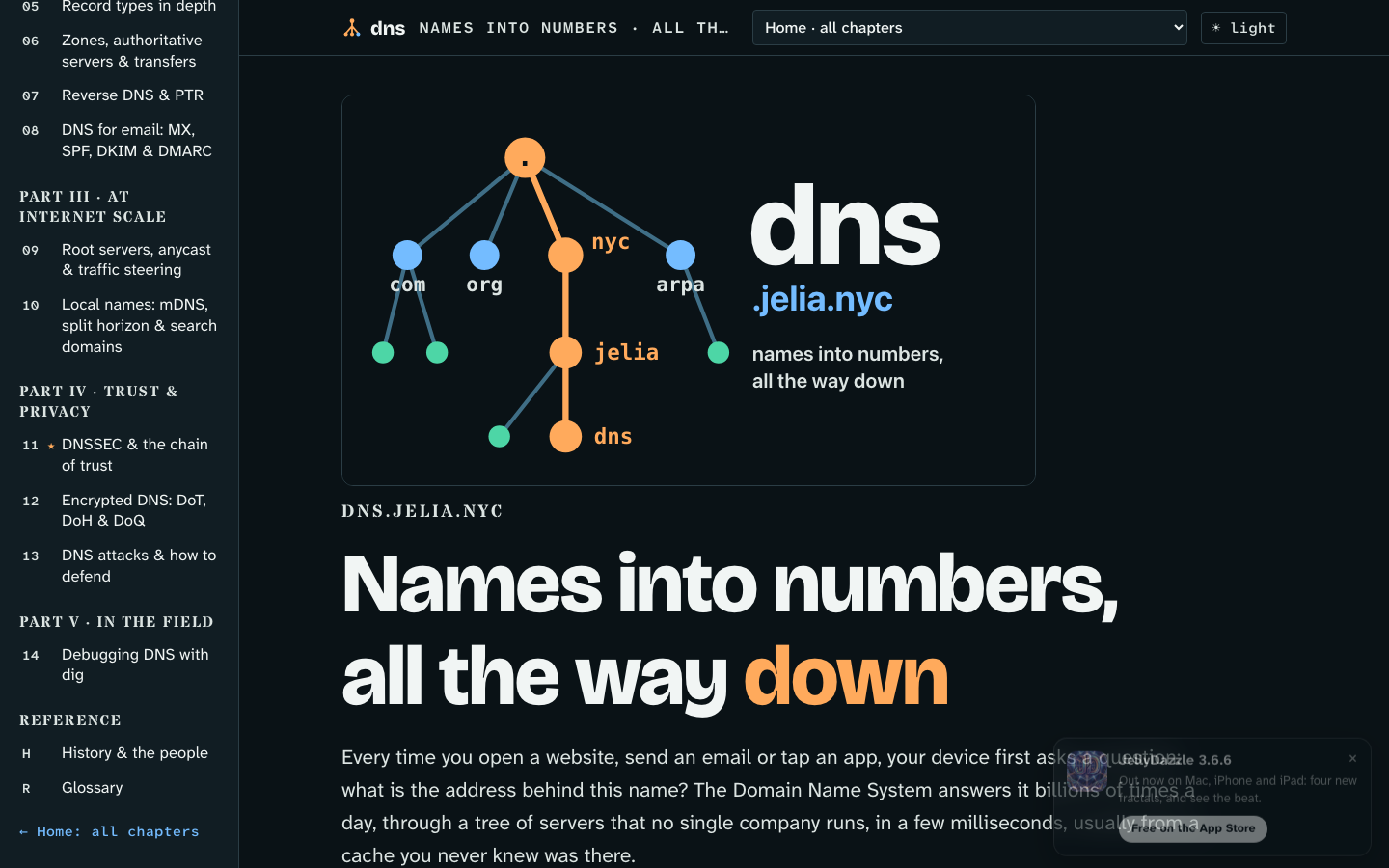
dns.jelia.nyc is our new deep dive into the Domain Name System: how a name becomes a number, who is allowed to answer for it, and what can go wrong between the question and the answer.
It picks up where the DHCP and DNS chapter on networks.jelia.nyc stops. That chapter teaches the tree, caching and the common record types; this site takes them apart. It runs to fourteen chapters, a history and a glossary of 162 terms, written so a curious business owner and a working engineer can both get something from it. Every chapter has a narrated walkthrough and live instruments you can drive, and break, safely.
What it covers
- How a lookup works: the namespace and delegation, a DNS message byte by byte, and recursive resolution followed from the root down, with referrals, glue and CNAME chains
- Why changes take time: caching, TTLs and negative answers, and how to plan a TTL before you move a site
- Running a zone: record types in depth, SOA serials, zone transfers, reverse DNS, and the MX, SPF, DKIM and DMARC records that decide whether your mail is trusted
- Trust and privacy: DNSSEC and the chain of trust, DNS over TLS, HTTPS and QUIC, and the common attacks with the defenses that stop each one
- At scale and in the field: root servers and anycast, local names and split horizon, and debugging with dig until NXDOMAIN, NODATA and SERVFAIL read like plain English
How it is built
- Every instrument is a real computation running in your browser: a resolver that walks a simulated tree and caches, a header you can encode bit by bit, a TTL clock that expires entries, a DNSSEC chain that fails when you edit a record
- All examples use reserved names and documentation addresses; nothing on the page queries the live internet
- Every fact is checked against its source, mostly the RFCs themselves, and every chapter lists them
- Large type, high contrast, dark mode and a color-blind friendly palette throughout
It is the same knowledge we rely on every day running mail, sign-on and web services for our clients. When a site works for one person and not another, or mail starts landing in spam, the answer is usually in these chapters.
Read it: dns.jelia.nyc. Start with the namespace and delegation.